Rome holds the Colosseum, Forum and imperial palaces, but the story of Roman Italy is much larger than the capital. Beyond Rome, you can enter a city stopped by Vesuvius, walk through an emperor’s private estate, descend beneath a gladiatorial arena and study late Roman mosaics inside a Sicilian villa.
The best Roman sites in Italy outside Rome are Pompeii, Herculaneum, Hadrian’s Villa, Pozzuoli and Baia, the Campanian Amphitheatre, Verona Arena, Roman Brescia, Aquileia, Aosta, Grotte di Catullo, Villa Romana del Casale and Nora. They are not realistic as one short itinerary. Choose one regional cluster and connect archaeology with a city, coast or countryside base.
Explore This Guide
ToggleQuick Planning Answer
- Best first choice: Pompeii for the scale and detail of a complete Roman city.
- Best shorter visit: Herculaneum for preserved houses, upper floors and compact geography.
- Best day trip near Rome: Hadrian’s Villa in Tivoli.
- Best region for several sites: Campania, using Naples as a base.
- Best choices without a car: Pompeii, Herculaneum, Verona, Brescia and Aosta.
- Best choices for a road trip: Aquileia, Villa Romana del Casale, Nora and Saepinum.
- Best general time: April to June or September to October for comfortable open-air visits.
- Main planning issue: The sites span the whole country. Do not build a trip around a national ranking; choose by region and travel style.
Most major archaeological areas have exposed stone, limited shade and uneven surfaces. Check current opening times, ticket rules and accessible routes before travelling.
What Counts as a Roman Site Outside Rome?
This guide focuses on places beyond the Comune di Roma, the city’s administrative area. That is why Ostia Antica does not appear in the main list. It feels like an excursion outside central Rome, but it remains part of Rome municipality.
Ostia is still an excellent choice for travellers based in the capital. Its theatre, warehouses, baths and apartment blocks explain everyday urban life particularly well. Read it as a Rome day trip rather than part of a journey through Roman Italy beyond the capital.
The list also distinguishes Roman sites from earlier places later reshaped by Roman rule. Paestum is an important Roman town, but its most celebrated monuments are Greek temples. Syracuse and Taormina also have significant Roman layers, yet their headline theatres began as Greek structures. They belong more naturally in a wider ancient ruins itinerary.
How to Choose the Right Site
The most famous place is not automatically the best one for every trip.
- Choose Pompeii for streets, houses, public buildings and a full-city experience.
- Choose Herculaneum for a more compact site with exceptional preserved interiors.
- Choose Hadrian’s Villa for imperial architecture, gardens and landscape design.
- Choose Pozzuoli and Baia for amphitheatre undergrounds, baths and submerged archaeology.
- Choose Verona or Brescia for Roman history within an easy northern city break.
- Choose Aquileia for archaeology, museum collections and early Christian mosaics.
- Choose Villa Romana del Casale for late Roman art and domestic status.
- Choose Nora for a Phoenician, Punic and Roman city beside the sea.
- Choose Saepinum for a quieter rural road-trip stop with a readable street plan.
Best Roman Sites in Italy Outside Rome
1. Pompeii, Campania
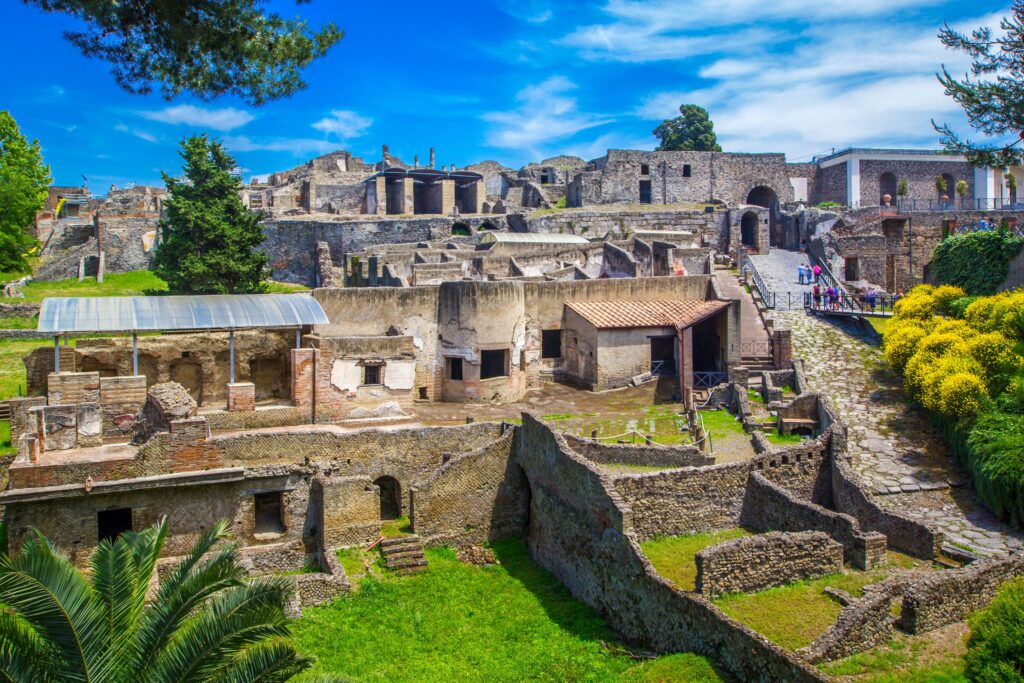
Pompeii is the strongest first choice because it preserves the structure of a city, not one isolated monument. Streets lead past houses, shops, fountains, baths, temples, theatres and an amphitheatre. The eruption of Mount Vesuvius in 79 CE fixed one dramatic moment in the city’s long history.
Allow at least half a day and choose a route before entering. Trying to see every open building usually creates fatigue without improving the visit. A guide is most useful for a first trip because paintings, room functions and political messages are easy to miss.
The Pompei Scavi–Villa dei Misteri rail stop is convenient for the Porta Marina side of the park. Other rail services use stations in modern Pompei, so check which station matches your entrance. Official tickets are nominative and visitor limits or timed-entry arrangements may apply.
Pompeii works for serious history travellers, older children and anyone comfortable with a long exposed walk. Summer visitors should start early, carry water and use the official map to find fountains and accessible routes.
2. Herculaneum, Campania
Herculaneum was also destroyed in 79 CE, but it gives a different view of the disaster. Volcanic material preserved carbonised wood, upper storeys and architectural details that rarely survive elsewhere. Several houses are easier to interpret than the larger, more fragmented blocks at Pompeii.
It is the better choice for a half-day visit, families with limited stamina and travellers who prefer depth over scale. Gradients and ancient surfaces remain part of the route, so it should not be treated as an entirely easy or step-free attraction.
Trains from Naples reach Ercolano Scavi, followed by a walk through the modern town to the entrance. Herculaneum pairs especially well with the National Archaeological Museum in Naples, where objects from the Vesuvian sites gain wider context.
Do not force Pompeii and Herculaneum into one rushed day unless your interest is selective. Two separate visits reveal their differences much more clearly.
3. Hadrian’s Villa, Tivoli, Lazio
Villa Adriana was created in the second century for Emperor Hadrian. It functions more like an architectural landscape than a conventional country house. Pools, reception spaces, baths, residential buildings and service areas spread across a large, gently changing terrain.
The Canopus is the best-known view, but the site becomes more interesting when you notice how water, sightlines and curved concrete forms connect the complex. This is a strong choice for architecture lovers and repeat visitors to Rome.
Hadrian’s Villa lies below Tivoli’s historic centre. Public transport is possible, but the final connection requires more planning than a direct city train. A car, taxi, local bus or organised excursion can simplify the day.
Do not confuse it with Villa d’Este. Villa d’Este is a Renaissance residence and garden in central Tivoli. Combining both is possible during a full day, but each has its own entrance, terrain and schedule.
4. Pozzuoli and Baia, Campania
The Campi Flegrei west of Naples offer one of Italy’s most varied Roman landscapes. In Pozzuoli, the Flavian Amphitheatre preserves extensive underground service spaces beneath the arena. Nearby Baia was a fashionable Roman resort known for villas, baths and thermal activity.
Part of ancient Baia now lies underwater because the ground level changed through bradyseism. The submerged park is not a normal walk-in ruin. Approved operators provide glass-bottom boat, snorkelling or diving visits, depending on current conditions and the visitor’s ability.
The dry-land Parco Archeologico delle Terme di Baia and the archaeological museum in Castello di Baia add the wider story. Treat the area as a full-day or two-day cluster rather than a quick add-on to central Naples.
Rail reaches Pozzuoli, but connections between the amphitheatre, Baia, Bacoli and individual archaeological sites require checking. A car, tour or planned combination of rail, bus and taxi is often more efficient. Opening routes can change, so consult the archaeological park before arrival.
5. The Campanian Amphitheatre, Santa Maria Capua Vetere
The Anfiteatro Campano is the right choice for travellers interested in gladiators and arena engineering. Its surviving underground passages show how people, animals and stage equipment moved below the spectacle above.
The adjacent Museo dei Gladiatori helps interpret the building. The wider Ancient Capua circuit can also include the archaeological museum and the Mithraeum, although access conditions and opening days may differ.
The practical detail many visitors miss is the location. Ancient Capua lies in modern Santa Maria Capua Vetere, not in today’s town of Capua. Enter the correct destination when checking trains, parking or accommodation.
This site pairs naturally with Caserta or Naples and suits travellers who have already seen Pompeii. It is less complete as a cityscape, but far more focused on gladiatorial culture.
6. Verona Arena and the Roman City, Veneto
Verona Arena remains part of city life. The first-century amphitheatre dominates Piazza Bra and still hosts opera, concerts and major events. That continuity makes it different from an excavated archaeological park.
A Roman route through Verona should continue beyond the Arena. Add Porta Borsari, Arco dei Gavi, Ponte Pietra and the Roman Theatre across the Adige. Together they reveal roads, gateways, entertainment and river connections inside ancient Verona.
Verona is one of the easiest options without a car. The historic centre is walkable from the railway station or reachable by local bus. Drivers should avoid entering the central ZTL and use a legal car park outside the restricted streets.
Daytime tourist access to the Arena changes around performances and technical preparations. Check the monument calendar separately from the opera or concert schedule.
7. Brixia Roman Archaeological Area, Brescia
Roman Brescia is a strong alternative for travellers who want a carefully presented site rather than a vast field of ruins. The Brixia area on Via dei Musei includes the Capitolium, Republican sanctuary and Roman theatre within the modern city centre.
Inside the Capitolium, original coloured-marble flooring survives. The Winged Victory of Brescia adds a major sculpture to the visit, while the nearby Museo di Santa Giulia expands the story into later periods.
Brescia is simple by train and local metro, and a car is unnecessary for the historic centre. The archaeological area usually closes on non-holiday Mondays, but current access and ticket combinations should be checked with Brescia Musei.
Combine Brescia with Verona for an efficient northern Roman route. Verona gives the monumental working arena; Brescia offers stronger museum interpretation and a more concentrated archaeological sequence.
8. Aquileia, Friuli Venezia Giulia
Aquileia was founded as a Roman colony in 181 BCE and developed into an important northern Adriatic city. Its remains are spread through the modern town rather than enclosed within one compact park.
The essential sequence is the Roman Forum, river port, National Archaeological Museum and burial area. The Patriarchal Basilica belongs to a later phase, but its vast early Christian mosaic floor shows how the Roman city continued into Christian Aquileia.
Allow a full day if you want both archaeology and the basilica complex. The town is flat and the main areas are walkable, although moving between separate locations takes longer than viewing a single monument.
A car gives the greatest flexibility. Car-free travellers can use the rail station at Cervignano-Aquileia-Grado and continue by bus, but the current connection should be confirmed. Grado makes an appealing coastal base, while Udine offers wider rail links.
9. Roman Aosta, Aosta Valley
Augusta Praetoria was founded in a strategic Alpine setting, and its Roman plan remains unusually legible within modern Aosta. The most rewarding route links the Arch of Augustus, Porta Praetoria, Roman Theatre and the underground Criptoportico Forense.
This is not one fenced archaeological park. It is a compact city walk with paid interiors and free outdoor monuments. The 22 m theatre façade creates the strongest visual moment, while the cryptoporticus gives a more atmospheric understanding of the forum area.
Aosta suits travellers who want Roman history alongside mountain scenery. The centre is reachable on foot from the station, so a car is unnecessary for the monuments. Drivers should respect the historic-centre ZTL and use perimeter parking.
Winter can be attractive, but snow, cold and shorter daylight change the rhythm. Check the current status of the Roman Theatre and combined archaeology tickets before visiting.
10. Grotte di Catullo, Sirmione, Lombardy
Grotte di Catullo is neither a cave nor the confirmed home of the poet Catullus. It is the surviving structure of a large Roman villa built after his death at the end of the Sirmione peninsula.
The site combines Augustan-age architecture, an archaeological museum, a historic olive grove and broad Lake Garda views. It works especially well for couples and mixed-interest groups because the walk can continue to Sirmione’s castle, lakefront and thermal attractions.
The old town is a ZTL, and visitors cannot simply drive to the archaeological entrance. Park outside the restricted centre, arrive by bus or use seasonal lake services, then continue on foot through the peninsula.
Summer brings heat and heavy day-trip pressure. An early visit or an overnight stay makes the ruins easier to enjoy.
11. Villa Romana del Casale, Sicily
Villa Romana del Casale near Piazza Armerina is the best Roman site in Italy for extensive late antique mosaics. The fourth-century residence uses floors to show hunting, mythology, sport, status and movement across the empire.
The Corridor of the Great Hunt is the headline work, but the value lies in the complete decorative programme. The baths, reception spaces, private rooms and dining areas show how art supported the life of an elite estate.
This is a covered mosaic route rather than an open ruined city. It suits art lovers, families and travellers who want a focused two-hour cultural stop. Raised walkways can become busy, making a quieter entry time valuable.
The villa stands outside Piazza Armerina, and the town has no railway station. A car, transfer or organised excursion is usually the easiest option. Seasonal shuttles and evening openings may operate, but they should be checked shortly before travel.
12. Nora, Sardinia
Nora occupies a narrow coastal promontory near Pula. It began as a Phoenician and Punic settlement before developing as a Roman municipium, so its identity is deliberately layered rather than exclusively Roman.
The visible Roman city includes a theatre, paved streets, baths, mosaics, houses, temples and a forum close to the sea. The setting is exceptional, but salt, sun and ongoing excavation mean the experience differs from an intact monumental city.
Nora works best as a half-day trip from Pula or Cagliari. A car is useful, while guided excursions solve the transport and interpretation together. Buying an entry ticket online does not automatically include a guided tour, so reserve the correct service if guidance matters.
The site is exposed and can be very hot in summer. Pair the ruins with Pula or a nearby coastal stop instead of adding another long archaeological visit.
A Quieter Road-Trip Alternative: Saepinum, Molise
Saepinum at Altilia is valuable because the Roman town plan remains easy to read in a rural landscape. You can follow streets through gates and past the forum, basilica, shops, baths and theatre without the intensity of a major urban attraction.
The site lies about 20 km south of Campobasso and is most practical by car. It is an excellent stop on a Molise or inland southern Italy road trip, but not a sensible detour for a short first visit to Italy.
Realistic Roman Italy Itineraries
One Full Day from Naples
Choose Pompeii for the entire archaeological day. Return to Naples for dinner rather than adding another large ruin.
Alternatively, visit Herculaneum in the morning and the National Archaeological Museum in Naples later. This combination connects the original buildings with the sculptures, mosaics and objects removed for preservation.
Two Days in Campania
Use Naples as your base.
- Day 1: Pompeii, with a focused route through the Forum, houses, baths and theatre district.
- Day 2: Herculaneum, followed by Naples or a shorter museum visit.
Replace the second day with Pozzuoli and Baia if you have already seen a Vesuvian site.
Four or Five Days Across Northern Italy
Begin with Verona’s Roman route, then continue to Sirmione and Brescia. Add Aquileia only when you have enough time for the longer move east and a full day in the town.
This route combines a working amphitheatre, Roman villa, temple complex and former port. Verona and Brescia are easy by rail; Sirmione and Aquileia need onward local transport.
Two Days in Central Sicily
Stay in or near Piazza Armerina.
- Day 1: Villa Romana del Casale, followed by Piazza Armerina’s historic centre.
- Day 2: Morgantina and Aidone, or Caltagirone for ceramics and Baroque streets.
This itinerary is best by car. It avoids trying to combine the villa with distant coastal cities in one rushed day.
Where to Stay for Roman Sites in Italy
Naples for the Strongest First Trip
Naples is the best all-round base for Pompeii, Herculaneum, Pozzuoli and the National Archaeological Museum. It suits car-free travellers and provides the widest choice of restaurants and accommodation.
The trade-off is daily transport and a busy urban atmosphere. Stay near a useful station if archaeology is the main purpose of the trip.
Pompei or Ercolano for Early Access
Sleeping in modern Pompei makes an early entrance and a full archaeological day simple. Ercolano works for a slower Herculaneum visit and access to the Vesuvian area.
Both are quieter at night than Naples and offer less variety after sightseeing. They suit travellers who prioritise the ruins over a city break.
Tivoli for Hadrian’s Villa and Villa d’Este
Tivoli is better than commuting from Rome when you want both villas at a relaxed pace. The historic centre provides evening atmosphere, but Hadrian’s Villa lies below town and still needs local transport.
Verona or Brescia for a Northern Rail Route
Verona is the livelier first-time base, with evening atmosphere and direct access to the Arena. Brescia is calmer and places Brixia and Santa Giulia within an easy cultural day.
Either works without a car. Choose Verona for entertainment and a classic city break; choose Brescia for museums and simpler pacing.
Aquileia, Grado or Udine for the Northern Adriatic
Stay in Aquileia for immediate archaeological access and quiet evenings. Choose Grado for couples and travellers combining history with the coast. Udine provides a larger urban base and broader transport choices, but requires a day trip.
Piazza Armerina for Villa Romana del Casale
Piazza Armerina is the logical overnight base for the villa and inland Sicily. It reduces driving and lets you add Morgantina, Aidone or Caltagirone without crossing the island repeatedly.
Pula or Cagliari for Nora
Pula is best for the shortest transfer, beach time and a relaxed evening. Cagliari offers more accommodation, food and public transport, but Nora becomes a dedicated half-day excursion.
Compare stays in Naples if Pompeii, Herculaneum and the museum form the core of your trip.
Getting Around and Avoiding ZTL Problems
Trains work particularly well for the Naples sites, Verona, Brescia and Aosta. They are less useful for Hadrian’s Villa’s final connection, central Sicily, Nora, Aquileia’s last leg and rural Saepinum.
A rental car earns its value on a Sicily, Sardinia, Molise or Friuli road trip. It becomes a burden inside Verona, Brescia, Aosta, Naples and Sirmione. Historic centres commonly use camera-controlled ZTL zones, and a rental car does not exempt you from fines.
Book parking with your accommodation or identify a legal car park outside the restricted centre. Never follow another vehicle through a ZTL gate. At rural archaeological sites, check the official arrival page rather than relying only on the map pin.
Tickets, Tours and Accessible Routes
Buy tickets from the official site when possible. Pompeii can use named tickets and entry controls, while Verona Arena access changes around events. Aquileia’s museum, basilica complex and archaeological areas do not all follow one identical schedule.
A guide adds the most value at Pompeii, Hadrian’s Villa, the Campi Flegrei and Nora. These sites contain layers or large spaces that are difficult to interpret from ruins alone. Browse guided tours of Pompeii and Herculaneum if you want transport or expert context included.
Accessibility varies within each archaeological area. Pompeii publishes an accessible route, and Grotte di Catullo offers a shorter route suitable for visitors with reduced mobility. Ancient paving, gradients and temporary closures can still affect what is reachable, so consult the attraction’s current accessibility page.
Best Time to Visit Roman Sites in Italy
Spring gives comfortable walking weather and longer daylight, although Easter periods and public holidays can be busy. It is one of the best seasons for Pompeii, Tivoli, Verona and Aquileia.
Summer requires a different rhythm. Start exposed sites early, carry water and avoid placing two large archaeological parks in one day. Verona performances can alter Arena access, while visits to submerged Baia depend on sea conditions and operator schedules.
Early autumn combines warm conditions with a more manageable pace. It is particularly good for Campania, Sicily and Sardinia once the most intense heat eases.
Winter suits the urban sites in Brescia, Verona and Aosta, plus covered mosaics at Villa Romana del Casale. Days are shorter, some routes or rooms may close, and snow or rain can make ancient surfaces slippery.
Nearby Places That Improve the Trip
- Pair Pompeii or Herculaneum with the National Archaeological Museum in Naples.
- Pair Hadrian’s Villa with Villa d’Este, but allow a full day and plan the transfer between them.
- Pair Verona with Sirmione for Roman ruins, lake scenery and an overnight change of pace.
- Pair Brescia with the Museo di Santa Giulia rather than treating the Capitolium as a photo stop.
- Pair Aquileia with Grado for the coast or Trieste for a larger city base.
- Pair Villa Romana del Casale with Morgantina and Aidone, or with Caltagirone.
- Pair Nora with Pula and the southern Sardinian coast.
Common Mistakes to Avoid
- Trying to connect distant sites simply because they appear on the same national list.
- Visiting Pompeii without a route, then using energy on minor streets instead of priority buildings.
- Treating Herculaneum as a smaller copy of Pompeii rather than a different preservation story.
- Navigating to modern Capua instead of Santa Maria Capua Vetere.
- Calling Paestum or Syracuse purely Roman and overlooking their Greek origins.
- Assuming an Arena di Verona performance ticket and a daytime monument ticket are the same.
- Driving into a historic-centre ZTL while following a navigation app.
- Arriving at Nora expecting an online admission ticket to include a guide.
- Wearing thin sandals on polished stone, gravel or uneven ancient paving.
FAQs
What is the best Roman site in Italy outside Rome?
Pompeii is the best first choice for most travellers because it preserves an entire urban landscape. Choose Herculaneum instead for a shorter, more detailed visit.
Is Pompeii or Herculaneum better?
Pompeii is better for scale, city planning and a full archaeological day. Herculaneum is better for preserved buildings, compact geography and visitors with less time.
Is Ostia Antica outside Rome?
Ostia Antica lies far from Rome’s historic centre but remains within the Comune di Roma. It is an excellent day trip, although this guide classifies it as a Rome site.
What are the best Roman sites in northern Italy?
Verona Arena, Brixia in Brescia, Aquileia, Roman Aosta and Grotte di Catullo are the strongest choices. Verona and Brescia combine especially well by train.
Which Roman sites can I visit without a car?
Pompeii, Herculaneum, Verona, Brescia and Aosta are practical by rail plus walking or local transport. Hadrian’s Villa is possible without a car but needs more connection planning.
Do Roman sites in Italy need advance tickets?
Major sites can use timed, named or capacity-controlled entry, particularly in busy periods. Book Pompeii early and check event-related access at Verona Arena.
Which Roman site is best for families?
Herculaneum is often the easiest balance of impact and manageable size. Verona and Brescia also work well because the ruins fit into compact city days.
Are Roman ruins in Italy wheelchair accessible?
Some sites provide adapted or shorter routes, but ancient paving and gradients limit complete access. Check the official accessibility map for the exact buildings open on your date.
How many days are needed for Roman sites outside Rome?
Allow two or three days for a Campania-focused trip. A wider northern or island road trip needs at least four or five days because transport matters as much as visit time.
Is Paestum a Roman site?
Paestum became a Roman city and contains Roman remains. However, its three monumental Doric temples are Greek and remain the main reason most travellers visit.
Building a Better Roman Italy Trip
The best journey is regional, not national. Begin with Pompeii and Herculaneum for ancient daily life, choose Tivoli for imperial design or follow Verona, Brescia and Aquileia for a northern route.
Sicily and Sardinia add different stories through mosaics, elite residences and cities reshaped by several cultures. Choose fewer sites, add the museum or landscape that explains them, and leave enough time to look beyond the headline monument.
Disclosure: This page may contain affiliate links. This means that we get a small commission from any purchase you make, at no additional cost to you!