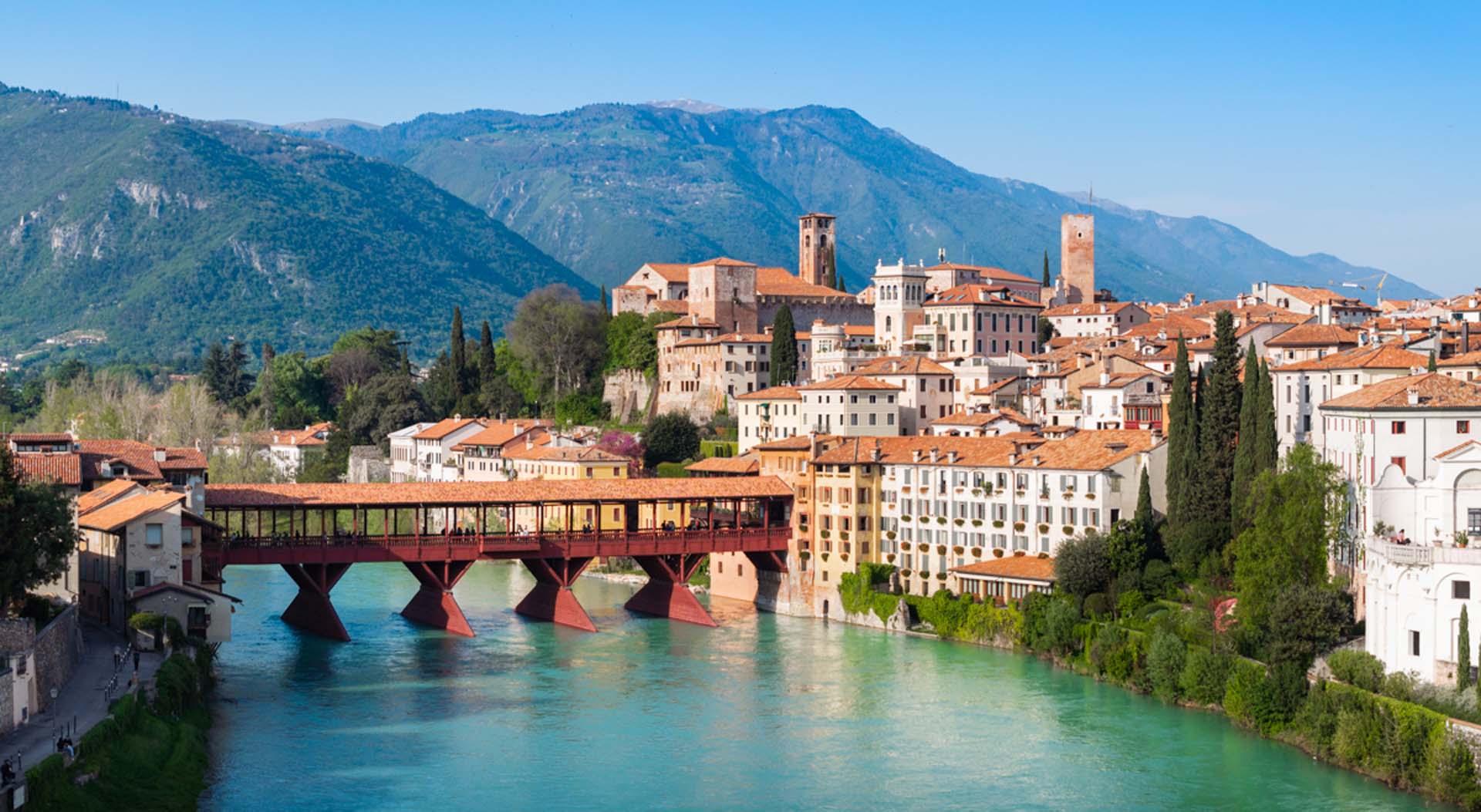
Bassano del Grappa sits on the River Brenta in northern Veneto, with a covered wooden bridge linking its historic centre to the Angarano district. The Ponte Vecchio is the town’s best-known landmark, but the surrounding streets give you good reasons to stay longer: paintings by Jacopo Bassano, the printing collections of Palazzo Sturm, and grappa museums beside the river.
A day trip works well, especially by train from Venice or Padua. An overnight stay gives you time for both major museums and dinner without a return journey to organise. The main distinction to understand is geographical: exploring Bassano is straightforward without a car, while visiting Monte Grappa above the town requires a separate transport plan.
Quick Planning Answer
- Best for: a walkable Veneto town combining art, riverside views and local food and drink.
- How long to spend: one full day for the centre and a museum; stay overnight for a slower visit or an excursion beyond town.
- Getting around: arrive by train and explore on foot. A car is more useful for the surrounding foothills.
- When to go: spring for white asparagus, or early autumn for comfortable sightseeing. Summer also brings cultural events.
- Main practical issue: the historic centre has restricted driving access. Choose a car park before arrival or arrange access with your accommodation.
- Museum planning: check opening days before choosing your travel date, particularly for a Tuesday visit.
Best Things to Do in Bassano del Grappa
Cross the Ponte Vecchio and Explore Both Banks
The Ponte Vecchio, also called the Ponte degli Alpini, is a covered timber bridge associated with Andrea Palladio’s design. Floods and wartime destruction have led to repeated rebuilding, so its importance lies in the survival of the design and its place in the town’s history.
Walk across for views along the Brenta towards the mountains, then continue into Angarano rather than immediately turning back. Seeing the bridge from beside the river helps you appreciate its wooden supports and its relationship with the buildings on either bank.
The bridge is closely connected with the Alpini, Italy’s mountain troops. The small Museo degli Alpini near its western end adds military context for visitors interested in the area’s wartime history.
Allow time for this part of town beyond taking a photograph. The bridge, nearby grappa stops and streets on both sides form a natural part of the same walk.
Walk Through Piazza Libertà and Piazza Garibaldi
Bassano’s two principal squares are close together, making them an easy starting point for understanding the centre.
Piazza Libertà brings together the Loggia del Comune, the church of San Giovanni Battista and the buildings associated with the town’s commercial past. Continue to Piazza Garibaldi for the Torre Civica, the church of San Francesco and the Museo Civico.
Between the squares and the bridge, include Piazzotto Monte Vecchio. This smaller historic space helps connect the more open piazzas with the streets descending towards the Brenta.
The Torre Civica offers an elevated view when open, but access follows a seasonal programme. Treat the climb as an optional addition after checking the museum’s current arrangements.
Explore Castello degli Ezzelini and Santa Maria in Colle
The Castello degli Ezzelini and the church of Santa Maria in Colle introduce the medieval part of Bassano. Include the castle area in the upper-town part of your walk, alongside Viale dei Martiri.
When open, the castle wall walk offers views over the Brenta and Palladio’s bridge. Access follows a seasonal programme, while the church and castle interiors have their own visiting arrangements. Check the official visitor information before planning to enter; the wall walk is not accessible to wheelchair users.
See Jacopo Bassano’s Paintings at the Museo Civico
The Museo Civico occupies the former convent of San Francesco beside Piazza Garibaldi. It is the strongest choice for visitors whose main interest is painting.
Its collections include works by Jacopo Bassano and his family, placing the town within the wider story of Renaissance art in Veneto. The museum also holds a substantial collection relating to Antonio Canova, including sculpture, drawings and documents, alongside archaeological material.
Choose this museum if you want to understand why Bassano matters beyond its bridge and distilling tradition. It deserves an unhurried part of the day rather than a brief stop between lunch and your train.
Temporary exhibitions can influence both the visit and ticket options. Check what is on when booking, especially if there is a particular collection or work you hope to see.
Visit Palazzo Sturm for Prints, Ceramics and a Bridge View
Palazzo Sturm stands above the Brenta, with a belvedere overlooking the river and Ponte degli Alpini. Its position makes it a logical stop when walking between the squares and the bridge.
Inside are the Remondini Print Museum and the Giuseppe Roi Ceramics Museum. The Remondini collections explain how a Bassano printing business distributed books, devotional images, decorated papers and other printed material far beyond the town.
The ceramics collection introduces another important local industry, with examples tracing changing techniques and tastes.
If you have time for only one major museum, choose Museo Civico for painting and Canova, or Palazzo Sturm for printing, ceramics and decorative arts. Both add substance to a visit, but trying to rush through them can leave little time for the town itself.
Follow Viale dei Martiri
Viale dei Martiri combines views towards the mountains with one of Bassano’s most significant places of remembrance.
The avenue commemorates young partisans executed in September 1944. Memorials attached to the trees explain the meaning of the place, so take time to read them rather than treating the avenue simply as a viewpoint.
Include it as a separate part of your centre walk, away from the bridge and shopping streets. It adds an important perspective on a town whose history is closely connected with the surrounding mountains and the conflicts fought there.
Learn About Grappa at the Poli Museum
The Poli Grappa Museum stands on Via Gamba near the eastern end of the bridge. Its displays explain distillation and the production of grappa from grape pomace, the skins and other material remaining after winemaking.
The self-guided museum is currently free to enter, with tastings offered separately. This makes it an accessible introduction even for visitors who want to understand the craft without booking a longer experience.
There is an important distinction when planning: the Bassano museum is not the Poli distillery. The working distillery and another museum are in Schiavon, outside town. Check the location carefully before booking a distillery visit.
Nearby, Grapperia Nardini occupies its historic position at the bridge. Its Mezzoemezzo aperitif offers another connection with Bassano’s drinks tradition.
One Day in Bassano: A Practical Walking Route
Start at Piazza Garibaldi, which is convenient when arriving from the railway station. Visit the Museo Civico first if painting is a priority, then continue into Piazza Libertà.
From the squares, walk through Piazzotto Monte Vecchio towards Palazzo Sturm. Decide in advance whether you want to enter the museum or concentrate on the river-facing part of the walk.
Continue to the Ponte Vecchio, cross into Angarano and explore the streets near the western end. This is a sensible point for lunch before returning across the river.
Visit the Poli Grappa Museum near the bridge, then leave the remaining afternoon for Viale dei Martiri and the upper part of the historic centre. A café stop or aperitif fits naturally at the end, provided you have allowed enough time to return to the station.
For most visitors, one major museum plus the town walk makes a balanced day. Visiting both Museo Civico and Palazzo Sturm is more comfortable with an early start or an overnight stay.
Bassano Town or Monte Grappa: Plan Them Separately
The name can cause confusion: Bassano del Grappa is the town beside the Brenta, while Monte Grappa is the mountain massif above it. The addition “del Grappa” refers to the mountain and its wartime significance, rather than directly to the spirit.
Cima Grappa contains the military memorial commemorating soldiers killed during the First World War. It is a mountain excursion, reached by roads climbing well beyond the town.
A train to Bassano gets you to the town, not to the summit. For Cima Grappa, arrange onward transport and allow a separate portion of your itinerary. Check mountain weather and road conditions, particularly outside the warmer months.
Travellers mainly interested in the bridge, museums and food can enjoy a complete visit without going up the mountain. Those coming specifically for military history should consider staying longer so that the summit visit does not squeeze out the town.
What to Eat and Drink
Bassano’s most distinctive seasonal ingredient is Asparago Bianco di Bassano DOP, white asparagus grown in the town and surrounding municipalities.
Spring is the time to look for it on local menus. A traditional preparation pairs asparagus with eggs, oil and vinegar, while restaurants also use it in risottos and other dishes. Choose a preparation that lets the asparagus remain the main ingredient.
Baccalà alla vicentina, commonly served with polenta, is another regional dish worth looking for. It connects Bassano with the food traditions of the wider Vicenza area.
For drinks, decide between a short museum visit, an aperitif at the bridge or a dedicated tasting. Travelling by train also makes it easier to include a tasting without arranging a designated driver.
How to Get There and Where to Park
By Train
Bassano del Grappa has a railway station within walking distance of the historic centre. Venice and Padua are useful starting points, with direct regional services available on these routes; check the journey offered for your travel date.
From the station, follow the route towards Via Jacopo da Ponte and Piazza Garibaldi. You can begin sightseeing without taking a local bus or taxi.
Use the Trenitalia journey planner for both outward and return connections. For travel from Trento through the Valsugana, also check engineering notices, as some services may be replaced by buses during works.
From Vicenza, compare regional bus services with the rail connections shown for your date rather than assuming there is a direct train.
By Car
For a town-only visit, driving adds parking decisions without making sightseeing easier. It becomes more useful when Bassano is one stop on a route through smaller towns or the foothills.
Two established paid options are:
- Il Ponte, also called Cadorna: useful for approaching the centre near the Tempio Ossario and Piazza Libertà.
- Le Piazze: convenient for the railway-station side of town and Piazza Garibaldi.
Both are managed by SIS, whose website provides current access and parking information.
Set your navigation to the chosen car park rather than to the bridge. The historic centre includes a ZTL, or limited traffic zone, with access rules that visitors need to follow.
For accommodation inside a restricted area, ask the property for its approved arrival route and any vehicle-registration requirements before driving in. A room reservation alone should not be treated as permission to enter.
Walking and Accessibility
The main sights are close enough to connect on foot, but a compact centre does not mean every route is level. Streets between the upper town and river include gradients, and historic surfaces can be uneven.
Travellers with limited mobility should check the approach to their accommodation and the access arrangements of individual museums. The Torre Civica is a separate consideration because a tower visit involves a climb.
Where to Stay
Historic Centre Around the Main Squares
Angarano Near the Ponte Vecchio
Near the Railway Station and Centre’s Edge
Best Time to Visit
Spring is a particularly good choice for a food-focused visit, thanks to the white asparagus season. It also allows you to combine museums with time outside without building the entire day around indoor attractions.
Summer brings the Operaestate programme, with performances in Bassano and other towns across the surrounding area. Check the venue as well as the date: an event promoted under the festival name may take place outside Bassano itself.
Early autumn suits a walking and museum itinerary. Winter can also work for a short cultural break, but seasonal attractions such as the Torre Civica should not be assumed to be open.
Choose your date around the experiences that matter most. Museum opening days are more important than the season for an art-focused visit, while mountain conditions become central if you plan to include Cima Grappa.
Adding Bassano to a Veneto Trip
Bassano fits naturally into a wider Veneto itinerary, particularly one combining larger art cities with smaller towns.
Padua is a practical rail base for a day trip. Venice also works, although staying in Bassano allows more time for dinner and an evening walk.
For an architecture-focused trip, combine it with Vicenza. The two places offer different experiences: Vicenza has a more extensive concentration of Palladian architecture, while Bassano brings the river, wooden bridge and local craft traditions into a smaller walking area.
Nearby Marostica is another option, known for its walled centre and chessboard square. Check regional buses if travelling without a car, including the return service before committing to a combined day.
A full day in Bassano followed by one carefully chosen excursion is usually more satisfying than fitting several towns and Monte Grappa into the same visit.