Su Nuraxi Barumini is one of the clearest places to understand Sardinia before the Romans. About 60 kilometres north of Cagliari, this UNESCO-listed complex preserves a monumental Nuragic tower, defensive walls and the remains of a settlement that developed across many centuries.
The site is not a ruin visitors can explore independently. Entry is through a compulsory guided tour, and the route includes uneven stone surfaces, steps and narrow sections. Most travellers need about 90 minutes for Su Nuraxi alone, but Barumini deserves closer to half a day because the combined ticket also includes Casa Zapata and the Centro Giovanni Lilliu.
This is primarily a cultural day trip for archaeology enthusiasts, first-time visitors to southern Sardinia and road-trippers exploring the island’s interior. Travellers interested mainly in beaches may prefer the coastal ruins of Nora near Pula.
Jump to
ToggleQuick Planning Answer
Best for: culture travellers, archaeology enthusiasts, Sardinia road trips and families with children interested in history
Time needed: about 90 minutes for Su Nuraxi alone; approximately three hours for all three included cultural sites
Best day-trip base: Cagliari
Car needed: strongly recommended, although organised tours and limited regional buses provide alternatives
Entry: compulsory guided tour, usually departing every 30 minutes and lasting about one hour
Ticket: one combined ticket covers Su Nuraxi, Casa Zapata and the Centro Giovanni Lilliu
Terrain: uneven archaeological surfaces, stone steps and potentially narrow passages
Best period: spring and early autumn; summer visits are better outside the hottest part of the day
Main limitation: outdoor access can be restricted during bad weather or extreme heat
Why Su Nuraxi Is Different from Other Ancient Sites in Sardinia
A nuraghe is neither a Roman fort nor a medieval castle. These stone structures are unique to Sardinia and developed during the Bronze Age, when communities across the island constructed thousands of towers in different forms and sizes.
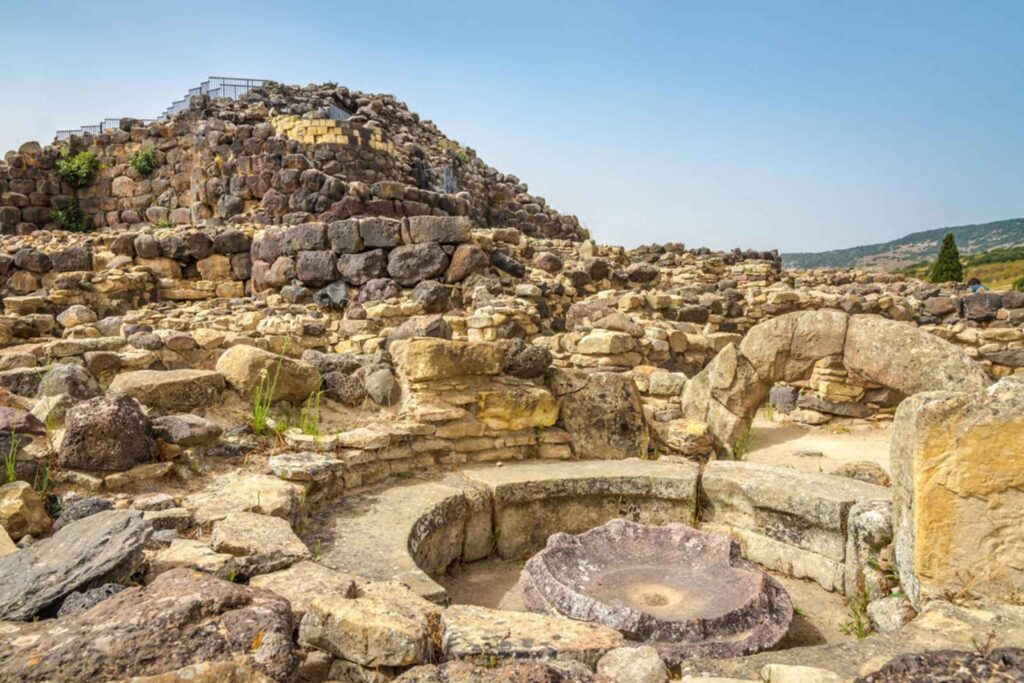
Su Nuraxi is the most complete surviving example of a complex nuraghe. Its first major structure was a central tower built during the second millennium BCE. Four additional towers and a massive curtain wall were later added around it, creating a fortified quatrefoil bastion.
The central tower originally rose more than 18 metres and contained three chambers connected by a spiral staircase. Its upper section no longer survives, but the remaining structure still shows the engineering skill required to build large corbel-vaulted rooms without mortar.
An outer defensive wall and a settlement of circular huts gradually developed around the main structure. Later homes used more complex layouts with central courtyards and several rooms, showing how the settlement changed as Nuragic society evolved.
The full purpose of nuraghi remains debated. Su Nuraxi clearly had defensive qualities, but archaeological evidence also suggests social, economic, residential, storage and ritual functions. It is more useful to understand the complex as the centre of a changing community than as a simple prehistoric fortress.
Occupation continued through Nuragic, Punic and Roman periods, with parts of the site reused until the third century CE and occasional later activity. The ruins eventually disappeared beneath collapsed stone and accumulated earth. Archaeologist Giovanni Lilliu directed systematic excavations between 1951 and 1956, and Su Nuraxi entered the UNESCO World Heritage List in 1997.
What You Can See Inside the Complex
The scale of the central bastion is the immediate focus, but the surrounding village provides much of the site’s historical value. The guided visit helps distinguish between building phases that may otherwise appear to be one continuous mass of stone.
Important features include:
The central tower and its surviving internal chambers
Four subsidiary towers connected by thick stone walls
The enclosed courtyard and well
An outer defensive wall with additional towers
Circular Bronze Age huts
Later courtyard houses divided into several rooms
The large communal structure generally known as the assembly hut
Evidence of Punic and Roman reuse
The contrast between the monumental centre and the tightly grouped village helps explain why Su Nuraxi is more than an isolated tower.
How to Visit Su Nuraxi Barumini: Tickets and Guided Tours
A guided tour is compulsory. Self-guided entry is not permitted because access is managed in small groups to protect the archaeological structures and keep visitors safe inside the more confined areas.
Tours normally depart every 30 minutes and last approximately one hour. Guiding is available in Italian, English and French, but travellers who need a particular language should ask when the next suitable departure begins.
One ticket includes three separate attractions:
Su Nuraxi Archaeological Area
Casa Zapata Museum Complex
Centro Giovanni Lilliu
Casa Zapata and the Centro Giovanni Lilliu also use guided visits, generally lasting about 30 minutes each. Once transitions and possible waiting periods are included, allow approximately three hours to see the entire cultural network without rushing.
At the time of research, individual tickets could be purchased at the site or arranged by contacting Fondazione Barumini, while organised groups were required to reserve. Online ticketing arrangements were still being developed, so check the official ticket page before travelling rather than relying on older booking information.
Opening and closing hours change through the year. The archaeological site is normally open daily, but its final admission depends on the seasonal closing time. Weather can also affect access, and the foundation may alter hours during periods of extreme heat.
Browse guided Su Nuraxi day trips from Cagliari if you want transport organised and do not plan to rent a car.
What the Su Nuraxi Visit Is Actually Like
Su Nuraxi is primarily an outdoor archaeological experience. Visitors move close to the basalt walls rather than viewing the complex from a distant platform, which makes the scale and construction easier to understand.
The route should not be treated like an ordinary museum visit. Expect uneven stone, changes in level and potentially confined sections. The foundation recommends comfortable clothing and non-slip footwear. Sandals with weak grip are a poor choice, particularly after rain.
Access to individual parts of the complex may change according to weather and safety conditions. Follow the guide’s instructions and do not expect every section to be open during every visit.
Summer requires additional preparation because the archaeological area is exposed to the inland heat. Carry water, use sun protection and choose an earlier or later tour when possible. The foundation sometimes adjusts opening hours during high-temperature alerts.
Visiting with Children
The scale of the towers, enclosed passages and reconstructed history can make Su Nuraxi engaging for school-age children. However, adults need to supervise children closely around steps, stone edges and uneven ground.
Families using a pushchair should contact the site before arrival to ask which parts of the current route are practical. A one-hour guided visit also leaves less flexibility than an attraction where families can enter and leave freely.
Animals are not normally admitted. Guide dogs are the exception, but their visit must be arranged in advance.
Accessibility and Reduced Mobility
Do not assume that the main archaeological route is fully accessible. The historic structure contains natural obstacles that cannot be removed without altering the site.
Visitors with reduced mobility should contact Fondazione Barumini before travelling and ask which areas can be reached under current conditions. Casa Zapata provides an accessible indoor route for visitors with disabilities or reduced mobility, making it the most practical part of the combined visit.
The official virtual reconstruction of Su Nuraxi can also provide useful context for areas that are difficult to enter physically.
Barumini Is More Than One Archaeological Site
A common planning mistake is treating Barumini, Su Nuraxi and Casa Zapata as different names for the same attraction. They are connected, but they are not in one building or on one continuous visitor route.
Su Nuraxi stands outside the main village, while Casa Zapata is in central Barumini. The Centro Giovanni Lilliu is a separate cultural venue associated with the archaeological area. Use the official map pin for each location rather than navigating only to “Barumini.”
Casa Zapata and Nuraxi ’e Cresia
Casa Zapata is a 16th-century residence built by the Aragonese Zapata family. During restoration work in the 1990s, archaeologists discovered another complex nuraghe beneath the palace.
Known as Nuraxi ’e Cresia, the structure can now be viewed from suspended walkways and through glass sections in the floor. This creates a direct visual link between the prehistoric settlement and the much later noble residence built above it.
The museum also contains archaeological finds from Su Nuraxi, historical material connected with the Zapata family and an ethnographic collection. Its Regional Museum of Launeddas focuses on Sardinia’s traditional reed instrument.
Casa Zapata is indoors, accessible to visitors with reduced mobility and normally remains visitable during rain. Its compulsory guided visit lasts about 30 minutes.
Centro Giovanni Lilliu
The Centro Giovanni Lilliu is named after the archaeologist who brought Su Nuraxi to international attention. Its permanent material includes photographs of the excavations, enlarged historical images and a scale reconstruction that helps visitors understand how the complex may once have appeared.
The centre also hosts temporary archaeological, artistic and cultural exhibitions. Because temporary displays change, check the current programme rather than planning around an older exhibition listing.
This stop is particularly useful after seeing the ruins. The model and excavation photographs make the different building phases easier to interpret.
A Realistic Half-Day Plan for Barumini
Begin at Su Nuraxi because its compulsory guided departure is the least flexible part of the day. Arrive with enough time to buy or confirm the ticket and ask when the next tour in your preferred language begins.
After the archaeological tour, visit the Centro Giovanni Lilliu while the site’s layout is still fresh in your mind. The models and excavation images provide context for structures seen during the guided walk.
Continue into central Barumini for Casa Zapata. Seeing a second nuraghe preserved underneath a 16th-century residence demonstrates how different historical periods overlap across the village.
Allow approximately three hours for all three locations, including the guided visits and movement between them. Add extra time for lunch rather than fitting another distant archaeological site into the same half day.
For a full-day itinerary, combine Barumini with the Giara plateau near Gesturi and Tuili. The plateau is known for its distinctive landscape and free-ranging Giara horses, although wildlife sightings cannot be guaranteed. Check current access, trail and guided-visit information before setting out.
A car makes this full-day combination considerably easier. Without one, choose an organised excursion that clearly states which attractions are included.
Where to Stay
Day Trip or Overnight Stay in Barumini
For most travellers, Barumini works best as a cultural day trip from Cagliari or as a stop while changing bases during a Sardinia road trip. The village is small, and its main visitor appeal is concentrated around the archaeological and museum network.
An overnight stay makes more sense when Su Nuraxi is part of a slower Marmilla itinerary. It allows more time for the Giara plateau, neighbouring villages and other rural archaeological sites without returning to the coast the same evening.
Stay in Cagliari for the Easiest First Visit
Cagliari offers the widest choice of accommodation, restaurants and evening activities. It is also the most practical base for travellers who want to book an organised excursion rather than drive.
Choose Cagliari when Barumini is one of several day trips and you also want city sightseeing, Poetto Beach or time on southern Sardinia’s coast.
Check stays in central Cagliari for the broadest choice and convenient access to organised Su Nuraxi tours.
Best Places to Stay in Cagliari
- 🔍Albergo Diffuso Birkin Castello
Review score & number of reviews: 8.9 · 2,280 reviews
Short description: Set within Cagliari’s Castello district, this dispersed hotel places travellers in the historic upper town. It offers air-conditioned rooms, free Wi-Fi, family rooms, luggage storage and an airport shuttle for an additional charge. The central setting suits couples and culture-focused visitors who want to stay among Cagliari’s historic streets.
Neighborhood / landmark: Castello district
Key facilities: Free Wi-Fi, air conditioning, family rooms, luggage storage, pets allowed, airport shuttle available at extra charge
Why it stands out: Its verified Castello address provides the most atmospheric historic-centre location in this selection. - 🔍Onlyrooms V – Portside & Train Station
Review score & number of reviews: 8.3 · 713 reviews
Short description: Located on Via Roma by Cagliari’s port and train-station area, this guest house is convenient for arrivals, departures and travellers relying on public transport. Rooms have air conditioning, free Wi-Fi and tea and coffee facilities, while the property also provides lift access, luggage storage and a 24-hour front desk. It is particularly practical for short and car-free stays.
Neighborhood / landmark: Via Roma, port and train-station area
Key facilities: Free Wi-Fi, air conditioning, lift, luggage storage, 24-hour front desk, bar, parking
Why it stands out: The Via Roma position is especially useful for reaching the railway station, port and central neighbourhoods. - 🔍Cramu Bed&Breakfast
Review score & number of reviews: 9.0 · 476 reviews
Short description: On Viale Trieste in central Cagliari, this B&B offers a smaller-scale stay near the city’s main transport area. Guests have free Wi-Fi, air conditioning, a terrace, lift access, luggage storage and a shared lounge. Family rooms are available, making it suitable for couples or families seeking central access without choosing a full-service hotel.
Neighborhood / landmark: Viale Trieste, central Cagliari
Key facilities: Free Wi-Fi, air conditioning, terrace, family rooms, lift, luggage storage, shared lounge
Why it stands out: It combines a strong guest score with a convenient central address near Cagliari’s station area. - 🔍Bluemoon Sardinia Roof Garden Jacuzzi
Review score & number of reviews: 9.5 · 1,626 reviews
Short description: This centrally located guest house adds practical road-trip features to a city stay, including on-site private parking and a parking garage. It also offers a terrace, hot tub, free Wi-Fi, air conditioning and lift access, with family rooms and an airport shuttle available. It suits couples who appreciate additional leisure facilities and drivers who want a confirmed parking option.
Neighborhood / landmark: Central Cagliari, Via Sebastiano Satta Poeta
Key facilities: Private parking, parking garage, hot tub, terrace, free Wi-Fi, air conditioning, lift, family rooms
Why it stands out: The combination of a central Cagliari address, private parking and a hot tub sets it apart from most city guest houses. - 🔍Palazzo Doglio
Review score & number of reviews: 9.2 · 1,800 reviews
Short description: Palazzo Doglio is a five-star hotel in central Cagliari for travellers seeking a more comprehensive hotel stay. Booking.com lists a restaurant, bar, spa and wellness centre, fitness centre, garden and terrace, alongside free Wi-Fi, family rooms and private parking. It suits couples and travellers who want dining and wellness facilities on site before or after an inland excursion.
Neighborhood / landmark: Central Cagliari, Vico del Logudoro
Key facilities: Restaurant, bar, spa and wellness centre, fitness centre, garden, terrace, free Wi-Fi, private parking
Why it stands out: It offers the most extensive facilities in this selection, including on-site dining, wellness and fitness options.
Stay in Barumini or the Marmilla Countryside for Slow Travel
Barumini and the surrounding Marmilla area suit road-trippers who prefer rural accommodation, quieter evenings and shorter access to Su Nuraxi and the Giara plateau.
The trade-off is a smaller choice of restaurants and services. A car is strongly recommended, especially for countryside accommodation outside the village.
Compare stays in Barumini and the Marmilla countryside for convenient access to Su Nuraxi and a slower inland itinerary.
Best Places to Stay in Barumini and Marmilla
- 🔍B&B Casa Piras IUN3880
Review score & number of reviews: 9.4 · 344 reviews
Short description: This well-reviewed B&B sits in Barumini village and offers air-conditioned rooms with private bathrooms, free Wi-Fi and tea and coffee facilities. Guests can use the garden, terrace, outdoor furniture and picnic area, while family rooms and free parking add practical value. It suits couples, families and road-trippers who want a small-scale base within Barumini.
Neighborhood / landmark: Barumini village
Key facilities: Free parking, free Wi-Fi, air conditioning, garden, terrace, family rooms, luggage storage
Why it stands out: It pairs the strongest review history among the village stays with a garden and free parking. - 🔍B&b Ventuno Barumini
Review score & number of reviews: 9.1 · 283 reviews
Short description: Located on Via Cagliari in Barumini, this B&B provides air-conditioned rooms, free Wi-Fi, family rooms and tea and coffee facilities. A garden, terrace, outdoor furniture and picnic area provide useful outdoor space, while luggage storage and private check-in support shorter stays. It works well for couples and families who prefer a village base with outdoor facilities.
Neighborhood / landmark: Via Cagliari, Barumini village
Key facilities: Free Wi-Fi, air conditioning, garden, terrace, family rooms, luggage storage, private check-in
Why it stands out: The garden, picnic area and children’s outdoor equipment make it particularly practical for families. - 🔍Diecizero Affittacamere
Review score & number of reviews: 8.7 · 135 reviews
Short description: Diecizero Affittacamere is listed by Booking.com as a B&B on Viale Umberto in Barumini. Alongside air-conditioned rooms and free Wi-Fi, it provides an on-site restaurant, bar, terrace, snack bar, table tennis and mini golf. Free parking and pet-friendly accommodation add flexibility for travellers exploring inland Sardinia by car.
Neighborhood / landmark: Viale Umberto, Barumini village
Key facilities: Restaurant, bar, terrace, free parking, free Wi-Fi, air conditioning, table tennis, mini golf, pets allowed
Why it stands out: Its combination of dining, leisure facilities and free parking is unusual among Barumini’s smaller stays. - 🔍Il Borgo dell’Arcangelo
Review score & number of reviews: 9.4 · 85 reviews
Short description: This agriturismo lies in the Marmilla countryside around Barumini and offers a rural alternative to staying in the village centre. Booking.com displays a garden, bar, free Wi-Fi, air conditioning and free private parking, together with walking and cycling activities. It suits couples and self-driving travellers who want a farm-style inland base for exploring the surrounding area.
Neighborhood / landmark: Marmilla countryside near Barumini
Key facilities: Free private parking, free Wi-Fi, air conditioning, garden, bar, walking tours, cycling activities
Why it stands out: It is the only agriturismo in this selection and combines rural accommodation with free private parking. - 🔍Hotel Su Nuraxi
Review score & number of reviews: 7.8 · 151 reviews
Short description: Set on Viale Su Nuraxi in Barumini, this three-star hotel is a location-focused option for travellers visiting the archaeological area. It has a restaurant, garden, terrace, free Wi-Fi, air conditioning, family rooms and free private parking, together with a children’s playground. It suits drivers and families who prioritise on-site dining, outdoor facilities and straightforward parking.
Neighborhood / landmark: Viale Su Nuraxi, Barumini
Key facilities: Restaurant, free private parking, free Wi-Fi, garden, terrace, family rooms, children’s playground
Why it stands out: Its Viale Su Nuraxi location, restaurant and free private parking make it a practical overnight road-trip stop.
Getting to Barumini by Car or Public Transport
Driving from Cagliari
Su Nuraxi is approximately 60 kilometres from Cagliari. A car provides the simplest access and makes it possible to combine the archaeological area with Casa Zapata, the Giara or another stop in Marmilla.
Set your navigation directly to the official Su Nuraxi archaeological area rather than Barumini town centre. Casa Zapata has a separate location, so save both map pins before departure and follow current visitor-parking signs on arrival.
Travellers crossing Sardinia can use Barumini as a stop between the south and central or western parts of the island. A dedicated return trip from Olbia, Costa Smeralda or Alghero is much less efficient and is worthwhile mainly for visitors with a strong interest in archaeology.
Visiting Without a Car
A car-free visit is possible only with careful planning. Barumini does not have a useful passenger rail connection to the archaeological entrance, and regional bus services can be limited, particularly on weekends and outside school-day schedules.
Check the current ARST journey planner for both the outward and return trip. Confirm where the bus stops, how the stop relates to Su Nuraxi and whether the final return leaves enough time for the compulsory guided tour. Do not plan around only the outward connection.
An organised tour from Cagliari is normally the most practical option without a car. Before booking, check whether the excursion includes only Su Nuraxi or also Casa Zapata, the Centro Giovanni Lilliu or the Giara.
Best Time to Visit Su Nuraxi
Spring and early autumn provide the most comfortable conditions for an outdoor archaeological visit. Temperatures are generally more suitable for walking across exposed stone, and a full day combining Barumini with the Giara is easier to manage.
Summer remains possible, but inland heat can be intense. Choose a morning or later visit, carry water and check the foundation’s channels for temperature-related changes.
The site is normally open during winter, but rain or unsafe surfaces can restrict access. Casa Zapata and the Centro Giovanni Lilliu remain useful indoor alternatives when the outdoor archaeological area cannot be visited safely.
Su Nuraxi or Nora from Cagliari
Su Nuraxi and Nora are both major archaeological day trips from Cagliari, but they represent different periods and travel experiences.
Choose Su Nuraxi for Bronze Age Sardinia, monumental stone architecture and a site that is specific to the island’s Nuragic civilisation. The experience is inland, guided and focused almost entirely on archaeology.
Choose Nora near Pula for Phoenician, Punic and Roman remains in a coastal setting. Nora is easier to combine with a beach, a meal in Pula or a wider South Sardinia itinerary.
For a first cultural trip, Su Nuraxi offers the more distinctively Sardinian experience. Nora is the better option when archaeology needs to fit into a coast-focused day.
Common Mistakes to Avoid
Arriving without allowing time for the next compulsory guided departure
Treating Su Nuraxi as a quick roadside photo stop
Assuming Casa Zapata is inside the main archaeological area
Wearing smooth sandals on uneven or potentially slippery stone
Planning a bus journey without checking the final return connection
Expecting the complete route to be suitable for limited mobility
Visiting at the hottest part of a summer day without water or sun protection
Trying to combine Su Nuraxi, all included museums and the Giara in a rushed half day
FAQs
Can Su Nuraxi be visited without a guide?
No. Entry to the archaeological area is through a compulsory guided tour. Tours normally depart every 30 minutes and last about one hour.
How long should I spend in Barumini?
Allow about 90 minutes for Su Nuraxi alone. Set aside approximately three hours for Su Nuraxi, Casa Zapata and the Centro Giovanni Lilliu. Add most of the day if you also want to explore the Giara.
Is Casa Zapata included in the Su Nuraxi ticket?
Yes. The combined ticket covers Su Nuraxi, Casa Zapata and the Centro Giovanni Lilliu, with guided visits included.
Are guided tours available in English?
Yes. The foundation lists Italian, English and French as available languages. Ask when the next English-language departure begins.
Can Su Nuraxi be visited when it rains?
Access may be restricted during bad weather for safety reasons. Casa Zapata and the Centro Giovanni Lilliu are indoor alternatives that remain visitable in different weather conditions.
Is Su Nuraxi suitable for visitors with reduced mobility?
The main archaeological area has uneven surfaces, steps and historic access limitations. Contact the foundation before visiting to confirm the currently accessible route. Casa Zapata has an accessible indoor visitor path.
Disclosure: This page may contain affiliate links. This means that we get a small commission from any purchase you make, at no additional cost to you!